May 28, 2016 | Climate change, English, environment, Global Public Goods, North-South, Passage au crible (English)
By Weiting Chao
Translation: Lea Sharkey
Passage au crible n° 141
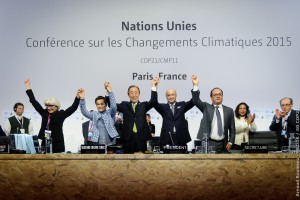
Source: Flickr
The Paris Climate Conference (COP21) opened in Le Bourget on November 30, 2015. The conference reunited 147 State Leaders, negotiators representing 195 countries and 50 000 participants. On December 12, a global agreement replacing the Kyoto Protocol has been adopted. The member States envisioned a limitation of the rise of global temperatures well below 2°C and sought to keep up the actions undertook to stop the temperature rise at 1,5°C in relation to pre-industrial levels.
> Historical background
> Theoretical framework
> Analysis
> References
Historical background
Global warming is today one of the main threats to the survival of the human kind. In order to cope with this issue, the United Nations Framework Convention on Climate Change (UNFCCC) was signed in 1992 by 153 countries. With respect of equity, this document had been drafted to identify, both for industrialised and developing States, a principle of common and differentiated responsibility. Five years later, the UNFCCC signatory countries adopted the Kyoto Protocol, first legally binding global instrument meant to compel developing countries to reduce their GHG emissions (GreenHouse Gas). Or, the United States pointed out an infringement to the development of the American economy and hence opposed the ratification of the treaty. The protocol was nonetheless enforced when ratified by Russia in 2005. As the protocol was to expire by the end of 2012, the post-Kyoto period had been considered from then. According to the roadmap signed in 2007 in Bali, the States had to finalise a new document in Copenhagen in 2009 (COP 15). But if that summit successfully gathered a large number of leaders, NGOs and civil societies, no significant progress had been made then. In Copenhagen, the final draft had been negotiated in a closed session by a small group composed of the USA, and the BASIC group of emerging countries (Brazil, South Africa, India and China). However, the text did not pass. At COP 18, which took place in Doha in 2012, the Kyoto Protocol has been extended until 2020, while postponing the adoption of a new treaty to year 2015. Two weeks before the opening of COP21, Paris was hit by unprecedented attacks, on November 13 2015, which resulted in 130 killed and 352 injured. Security measures worldwide have been strengthened because of the terrorist threat, and the holding of COP21 even questioned. Yet, the summit took place without any incident.
Theoretical framework
1. A model of joint regulation. At the heart of the climate talks, we may identify hierarchies of authority. In this respect, the United Nations represents an asymmetric interdependent system between unequal parties. The rules are constantly re-shaped, resulting from action or non-action. According to Marie-Claude Smouts, two types of regulation, two rationales constantly confront each other in this type of organisation. The first one comes from dominant players holding the power to shape new rules and have them adopted in order to master the collective game. The second one comes from subordinates. The latter strive to set up bypassing and dodging strategies to nonetheless influence the final decision.
2. North-South de-territorialization and re-territorialization. In the post Cold War period, the territoriality principle has gone through major transformations. The territory of the State has been questioned by material and immaterial transnational flows, which result from lighter border controls and decline of spatial and logistical constraints. This has been followed with the de-territorialisation of international exchanges that led to a reorganisation of the governance in various sectors (security, ecology, migrations, health, etc.). But recent multilateral negotiations on climate change introduced a confrontation of this rationale with the traditional North-South divide, which hampered the adoption of a global agreement. In fact, the climate threat imposes a global management of the atmosphere as a common good, which breaks out the classic notion of territorial appropriation.
Analysis
The UN Climate Conference represents a major opportunity for the member States. In 2015, 195 countries ratified the UNFCCC. In the multilateral negotiations, diversity and heterogeneity of the parties add up to the United States hegemony. In the light of this, the US opposed the ratification of the Kyoto Protocol considering it an infringement to the development of its own economy. Consequently, the non-action of a dominant country considerably diminished the efficiency of the public authority on international cooperation. Moreover, many countries have decided to get not involved in the second phase of the Protocol (2013-2020). Moreover, after 2000, the emerging BASIC changed the situation. China became one of the most prominent CO2 emitters in the world, exceeding the emissions of the United States in 2006. In Copenhagen, the two leaders and emerging countries jeopardised the mutual trust built within the United Nations, which eroded even more the negotiations. As a consequence of this tense climate, the Copenhagen agreement has not been adopted by the UNFCCC, even though not legally binding for the parties.
On the other hand, the subordinate countries attempted to expose their point of views during the talks through an “iterative game“, which contributed in pacifying conflicts between members. In this framework, the parties sought any opportunity to meet their expectations on specific topics, but had to compromise on some others, resulting in a feeling of eternal restarting. This process compelled the COP21 to come up with reciprocal commitments. It is worth remembering that the action taken to limit the temperature rise to 1,5°C and the expression “loss and damage” firstly mentioned by the alliance of small Island States have been included in the Paris Agreement. However, these principles were strongly rejected by the United States.
It should be underlined that this document is the first universal agreement in which all of the developed countries, together with developing countries, have recognised their obligations to manage their GHG emissions. From this point of view, the traditional North-South governing mode has been altered according to the threats related to climate change. This de-territorialisation and re-territorialisation movement erodes the localisation constraints. For example, an IPCC report (Intergovernmental Panel on Climate Change) indicates that climate change is today the first cause of regional conflicts and forced human migrations. Moreover, the de-territorialisation process is also linked to the joint policies that countries have committed to, in order to achieve economic stability and levelling of social challenges. The long-term objective is really ambitious (below 2°C) and entails a collective effort. It raises an issue of financing. In this regard, the Paris Agreement sets an obligation to developed countries to support poor countries and help them tackle climate change. From 2020, 100 Billion dollars will then be delivered on a yearly basis. Developing countries are also invited to fund them on a voluntary basis. This global agreement will be enforced when 55 countries counting for at least 55% of the global emissions will have completed their ratifying procedure. However, the text also introduced the INDC (Intended Nationally Determined Contributions) for the reduction of the countries’ GHG emissions. This tool enables countries to determine their own contributions on a voluntary basis, according to their respective capacity, economic context and national priorities. In other words, this very ambitious treaty is barely binding from a legal point of view. In the future, an achievement-oriented agreement should mainly rely on the respective expectations of the parties influential enough to make a mark on the outcome of the negotiations.
References
Aykut Stefan C. and Dahan Amy, Gouverner le climat ? 20 ans de négociations internationales, Paris, Presses Science po, 2015.
Chao Weiting, « Le triomphe dommageable des passagers clandestins. La conférence de Doha », in: Josepha Laroche (Éd.), Passage au crible, l’actualité internationale 2012, Paris, L’Harmattan, 2013, pp. 111-115.
Smouts Marie-Claude (Éd.), Les nouvelles relations internationales : pratiques et théories, Paris, Presses Science po, 1998.
Mar 28, 2016 | Climate change, English, environment, Global Public Goods, Passage au crible (English)
By Valérie Le Brenne
Translation: Lea Sharkey
Passage au crible N° 138
 Source: Pixabay
From November 30 to December 11, 2015, the 21st Convention of the Parties to the United Nations Framework Convention on Climate Change (COP 21). Following intense talks, the negotiators compromised on a 40 pages agreement, aiming to restrict the global warming to 2 degrees Celsius. Presented as the major missing issues of this Summit, oceans were finally taken into account but only with limited scope. As such, the preamble of the appendix details that, « Parties to this Agreement […] note that it is important to maintain the integrity of all ecosystems, including oceans ».
> Historical background
> Theoretical framework
> Analysis
> References
Historical background
Signed in 1992 at the Earth Summit in Rio, the UNFCCC counts 196 members today. Every member state recognises the existence of a climate change caused by human activity, and commits to reducing their greenhouse gas emissions (GHG). Enforced in 1994, the agreement plans that a conference of the Parties (COP) should be held to evaluate the policies carried out in this regard and negotiate new dispositions.
In 1997, the COP3 resulted in the signature of the Kyoto Protocol, assigning to « the developing countries and transitional economies quantified targets regarding GHG emissions » (Aykut, 2015). But, the fact that the US did not ratify the accord, added to a patent lack of results triggered a deep crisis that peaked in Copenhagen in 2009. After two years of discussions, member states could not agree on the next treaty bound to take effect in 2020, ending the summit in failure. Postponing the deadline to 2015, the Paris talks thus appeared as the « last chance summit ». The role of the Intergovernmental Panel on Climate Change in allowing the climate issues to reach political agenda must be here underlined. Founded in 1998, the IPCC « assesses the current state of scientific, technical and socio-economical knowledge on climate change, their causes, potential impact and response strategies ». Since its creation, the IPCC has published five reports (1990, 1995, 2001, 2007 and 2013-2014), each one delivered with a synthetic guidance note addressed to policymakers, elaborated by the Subsidiary Body for Scientific and Technical Advice (SBSTA). In their last report, experts alerted on the impacts of climate change on oceans. Besides the risks induced by the rise of sea-level, scientists evidenced the issues of the oceans acidification and global warming of the seas, due to the absorption of up to 30% of the human-related carbon dioxide emissions released in the atmosphere. In fact, these brutal bio-geo-chemical transformations impact the marine system overall and is has been already jeopardising many species.
Theoretical framework
1. The scientific legitimisation of an environmental cause. IPCC most recently published scientific conclusions contributed in establishing the legitimacy of this environmental cause. This tends to demonstrate how the knowledge structure (Strange, 1994) plays a major role in shaping issues and allowing them to access political agenda.
2. Pooling hybrid resources. In spite of IPCC alerts, oceans issues were not inscribed on the COP21 agenda. As a response, many representatives from the civil society, scientific world, public and private sectors gathered in the Ocean & Climate Platform (OCP), and organised the Ocean for Climate Days from December 2 to 6, off Le Bourget Talks.
Analysis
It should be underlined that this subject did not appear all of a sudden on the climate change global agenda. In fact, previous IPCC reports stated the alarming state of the risks induced by the rise of the sea level. Nevertheless, their last assessment revealed new emergency issues. Indeed, this rationalisation worked for the legitimisation of the topic while encouraging initiatives focusing on marine preservation. As such, the Global Ocean Commission had been launched in February 2013, London. Composed of key political figures such as former foreign affairs minister David Miliband or Costa Rica President José Manuel Figueres, the GOC published in June 2014 a report entitled From Decline to Restoration. This emergency plan for world oceans is prescriptive and addressed to political leaders. The TARA Expedition research project stands out as well and has been published in the prestigious American Science review in May 2015. This work has for instance evidenced the consequences of global warming on plankton, microorganisms at the base of all the sea life chain. American Secretary of State John Kerry has also created the Annual Our Ocean Conference in 2014. The second edition took place in Valparaiso, Chile, in September 2015, and has been marked by several official announcements regarding the creation of important marine preservation areas, such as the one located around Easter Island. Eventually, on the eve of the COP21 grand opening, eleven countries signed the Because the Ocean Appeal launched by the Chilean and French Government, the Prince Albert II of Monaco Foundation, the Global Ocean Commission, the Institute for Sustainable Development and International Relations (IDDRI) and TARA Expeditions. This declaration notably claims “1) the publication of a special IPCC Ocean Report, 2) The respect of the Sustainable Development Objective n°14 regarding the ocean and marine resources 3) The creation of an ‘Ocean task force’ placed under the aegis of the UNFCCC”.
This renewed interest was not enough to list the topic on the Parisian Summit programme. This is why an international coalition of representatives from the civil society, scientific world and public and private sectors joined their resources in the Climate & Ocean Platform. Created on June 10, 2014, with the support of the Intergovernmental Oceanographic Commission (IOC) of the Unesco, this institution seeks “better consideration of the ocean in the climate talks“. Besides the Ocean Appeal for Climate, an online petition developed under the aegis of the American oceanographer Sylvia Earle, the OCP also drafted nine recommendations based upon and completing those proposed by the GOC in 2014. Finally, the organisation of the Ocean for Climate Days in the Climate Space Generation in Le Bourget provided entry points to the Blue Zone and furthered the talks with parties to the negotiation process. However, these initiatives do not dim the fact that eventually, COP21 only marginally considered oceans issues, a surprising fact in regard of the widespread, acknowledged and alarming scientific data.
References
Aykut Stefan, « Désenclaver les négociations climatiques. L’enjeu crucial de la COP 21 à Paris », Passage au crible, (133), Chaos international, 20 sept. 2015.
Aykut Stefan C., Dahan Amy, Gouverner le climat ? 20 ans de négociations internationales, Paris, Presses de Sciences Po, 2015.
Strange Susan, States and Markets: An Introduction to International Political Economy, Londres, Pinter, 1994.
Site officiel du GIEC, available to this web address :
https://www.ipcc.ch/home_languages_main_french.shtml.
Site officiel de la Plateforme Océan & Climat, available to this web address : http://www.ocean-climate.org/.
Dec 22, 2012 | Development, environment, North-South, Passage au crible (English)
By Weiting Chao
Passage au crible n°80
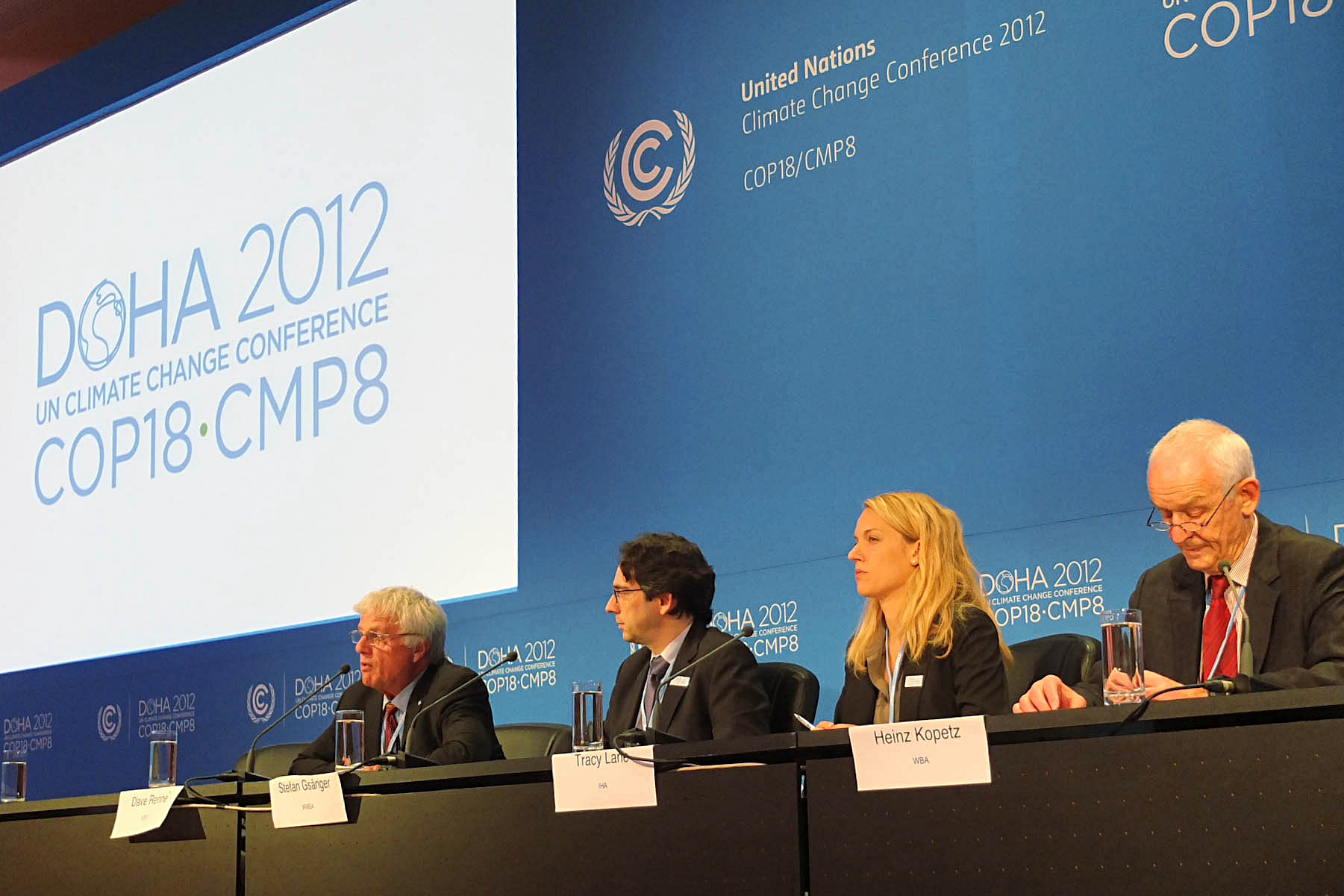 Source: Wikimedia
The 18th session of the Conference of the Parties to the UNFCCC (United Nations Framework Convention on Climate Change COP 18) and the 8th session of the Conference of the Parties serving as the Meeting of Parties to the Kyoto Protocol (CMP8) took place in Doha (Qatar) from 26th November to the 8th of December 2012. The outcome of the two-week negotiations, agreed by nearly 200 nations, extends to 2020 the Kyoto Protocol.
> Historical background
> Theoretical framework
> Analysis
> References
Historical background
Signed in 1997, The Kyoto Protocol is the only global agreement which sets binding obligations on industrialized countries. It is based on the UNFCCC, signed by 153 countries in 1992, which set the goal of reducing GHG emissions (greenhouse gas emissions).
The protocol divides the countries into two groups, Annex I and Non-Annex I countries, with the principle of common but differentiated responsibilities and the principle of equity. In 2001, the United States pulled out of the Protocol, saying that it would damage the US economy. This decision has proved detrimental to the success of the international efforts. Therefore, the EU (European Union) has played a leading role in maintaining the ongoing negotiations.
The Protocol came into effect on 16th of February 2005, following its ratification by Russia. Since the agreement was set to expire at the end of 2012, negotiations about the post-Kyoto period have been underway since 2005. During the Bali Conference (COP13, 2007), the participating nations agreed to the Bali Road Map which set out a two-year process to finalize a binding agreement for 2009 in Copenhagen. However, there was no significant progress and only a diluted version of the agreement was achieved. Indeed, as the Copenhagen Accord was not legally binding, it did not commit countries to agree to a new binding text. In 2011, Russia, Japan and Canada confirmed they would not participate in a second round of emission reductions under the new Kyoto Protocol. Further, the United States reaffirmed their commitment to stay out of the treaty. In 2011, at the Durban Climate Change Conference, a subsidiary body was established: it was an ad hoc Working Group, part of the Durban Platform for enhanced action set up to drive the development of another document. The adoption of a universal agreement on this issue was postponed to 2015, with expected implementation in 2020. In 2011, at the Durban Conference on Climate Change in Doha, however, negotiations led to a simple extension of the Kyoto Protocol until 2020.
Theoretical framework
1. Procrastination as a negotiation technique. Postponing the signing of a settlement ad libitum, while extending talks, is a well-known diplomatic strategy. The parties can hold up negotiations if they do not want any agreements to be reached.
2. The persistence of the North-South divide. After two decades of negotiations the difficulties between developed and developing countries have worsened considerably because of climate change, making the signing of any new treaty more difficult to achieve.
Analysis
The Doha agreement is designed to be a tool to resolve the problem of global warming governance. But in reality it only helps to keep the protocol and ensure that negotiations continue to take place. The second period of the Protocol commits the EU, Australia, Belarus, Kazakhstan, Liechtenstein, Norway, Switzerland, Ukraine, and Monaco to another 8 years (1 January 2013 to 31 December 2020). But these countries account for only 15% of global GHG emissions. In addition, they have disparate commitments ranging from a 20% reduction on emissions levels from 1990 for the EU to a decrease of only 0.5% compared to 2000 levels for Australia. Finally, this arrangement does not commit the United States, Canada, Japan, Russia, New Zealand and other emerging countries. However, at the very least, the agreement buys participants more time to implement policies against global warming. In other words, developing countries and countries outside the Kyoto Protocol can still enjoy a secure benefit until 2020. The failure of the first sequence of Kyoto and the withdrawal of United States emphasizes the considerable number of “free riders” who wish to evade the constraints of collective action (Olson). However, when a key player retires, it can be detrimental not only to the other participants but also to the success of the whole arrangement. A second problem is also caused if all stakeholders reject the implementation of the Treaty this would lead to an outright cancellation of the whole agreement. Parties tend to oscillate between these two scenarios because they believe that non-completion is ultimately the strategy that best suits their individual needs. Recent negotiations have been postponed to the post-Kyoto period, as participants remain uncertain about the costs and benefits of such an agreement. Accurate forecasting can be difficult: it can lead to, for example, an underestimation of the future costs. Moreover, parties tend to delay and wait to see how others engage with the agreement. All these factors lead to a state of procrastination. Even though numerous scientific studies have recently shown how the climate might deteriorate more quickly than expected, this policy of procrastination could lead to a major ecological disaster. In other words, the harmful policies of stowaways are already at work.
The conflict between developing countries and industrialized countries forms a central element of environmental governance. Therefore, the principle of common but differentiated responsibilities was recognized in 1992. This principle allows developing countries to increase their emissions to ensure their economic development. However, since some of them have emerged as BASIC countries (Brazil, South Africa, India, and China), the traditional North-South divide has intensified. It is also particularly complicated because China has now become the biggest CO2 emitter in the world, surpassing the emissions of the United States in 2006. During the post-Kyoto negotiations, many developed countries in the UNFCCC – including the United States and Australia – have therefore advocated the replacement of the Kyoto Protocol by a new text, which also includes the commitment of many of the countries of Annex I and developing countries. But for now, developing countries still refuse to accept any obstacle to their development. They demand that developed countries take the lead in a substantial reduction of GHG emissions.
We can see that there is little progress in the fight against global warming. The extension of the Kyoto Protocol only allows the negotiations to continue. To reach a real agreement and prevent an ecological disaster, states should abandon their strategy of procrastination, such as bringing NGOs into discussions. The EU, the U.S. and the BASIC need to play a role in the adoption of a new protocol. If the EU implements emission reductions, the United States and other emerging countries such as China cannot escape the “prisoner’s dilemma” of climate change.
References
Akerlof, George. A, « Procrastination and Obedience », American Economic Review, 81 (2), 1991, 1-19.
Churchman, David, Negotiation: Process, Tactics, Theory, (2nd Ed.), Boston, University Press of America, 1997.
Kontinen Tiina, Irmeli Mustalahti, « Reframing Sustainability? Climate Change and North-South Dynamics », Forum for Development Studies, 39 (1), mars 2012, 1-4.
Olson Mancur, Logic of Collective Action, Cambridge (Mass.), Harvard University Press, 1965.
Timmons Roberts J., Parks Bradley, A Climate Of Injustice: Global Inequality, North-South Politics, and Climate Policy, The MIT Press, 2006.Site de COP18: http://www.cop18.qa [15 décembre 2012].
Uzenat Simon, « Un multilatéralisme sans contraintes. Les engagements des États dans le cadre de Copenhague », Passage au crible, (15), 18 fév. 2010.